«The waters cross the capital of Sicily from all sides, where perennial sources also spring. Palermo abounds with fruit trees […] and within the circle of walls that are a riot of orchards, such is the magnificence of villas and how many fresh running streams, borne by canals from the mountains»: these are the words written by the Maghreb geographer Al-Idrisi in 1139. Guest of the Norman king Roger II, he described the beauty of Palermo, capital of a multicultural reign, overlooking the Tyrrhenian Sea, in the centre of the Mediterranean. The echo of these verses could come to mind visiting Laurent Ajina’s latest exhibition, as well as the evocative sound of water pouring from fountains, the colours and scent of flowers and fruits, the green of the gardens, the blue of the sky and the golden glare of the meridian light.
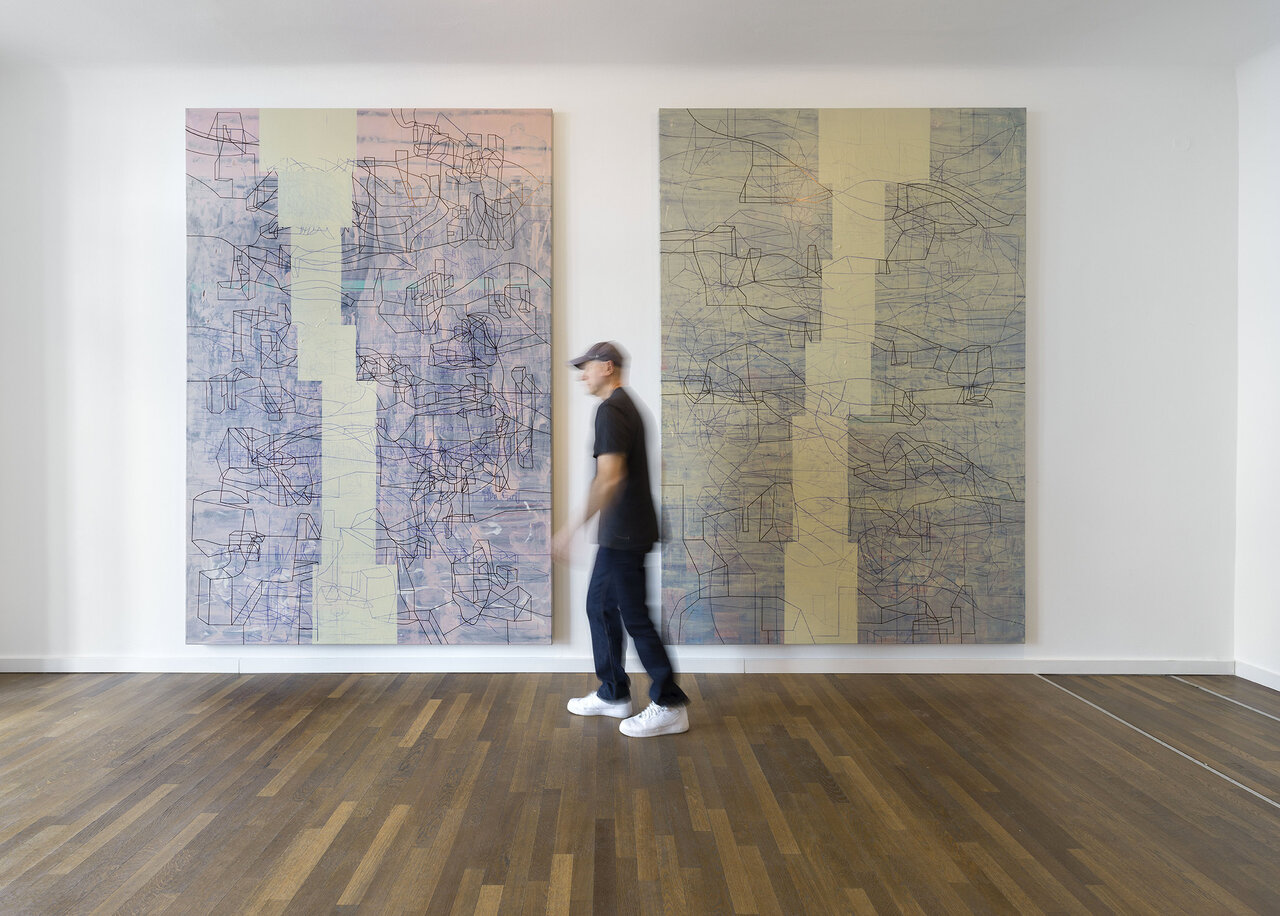
The artist conceived the exhibition as a large installation that starts at the entrance of the Crone gallery in Berlin, transformed ideally into the monumental atrium of an ancient “palazzo”, evoked by four large canvases that refer in their forms to imposing columns as if to support the architectural structure of the gallery. Then, entering the courtyard-garden of this imaginary palace, the artist has installed the four canvases of the "Flowers in the Wall" series, where the geometric shapes and the combination of colours of these abstract works become vehicles to transport the observer into an “other” place, potentially more complex than that of a figurative representation. Here, the square or rectangular coloured shapes are intertwined and connected to each other by black parallel and curved lines, dense in some parts of the surface whilst more spaced out in others. Geometric shapes that act as counterpoints introducing emotions through colour and referencing the screens of mobile phones that have now become a constant filter between our gaze and the world. It is also as if the artist had interiorized the centuries-old cultural and architectural stratification of Palermo, expression of the different civilizations that have followed one another here: Phoenician, Roman, Byzantine, Arab, Norman, Swabian, French, Spanish, etc. A unique place, at the crossroads between East and West and, in this clot of traditions, only apparently opposites, the artist has recognized elements in reference to his own biography being a Frenchman of Iraqi origin.
This new series of works entitled "Palermo Paintings" was conceived by the artist last January, when he found himself spending a quarantine at Palazzo Viola, in solitude due to the pandemic, overlooking the octagonal square of the Quattro Canti, the baroque heart of Palermo. The square is also known as the “Theatre of the Sun” because once a day each of the four buildings that compose it, is touched by sunlight. In this period of forced isolation, the artist was able to re-think and visually explore the architecture of the city, assimilating the images that had struck him most in his own journey through Sicily. From the Byzantine mosaics of the Palatine Chapel to the Mondello beach, from the Botanical Garden - among the most important in Europe and the Mediterranean area - to the cloister of the monastery of San Domenico with its banana trees and cycas plants originating from Asia, but also to sense the contradictions of the contemporary city and its difficult recent history. A pause that became an opportunity for an inner journey, mentally connected to the eighteenth-century tradition of the Grand Tour, when European travellers saw the island as the place to experience the stratifications of the past, testimonies of different civilizations that met and merged, demonstrating in the centuries that the migratory processes and the displacements of populations are a source of cultural wealth and creativity. For Ajina this investigation is resolved in a personal identification of the internal structures that make up the urban rhythm of the places where he lives or has lived, from Vienna to Los Angeles. A connection between past and present, between different elements, between order and chaos that the artist expresses through the stylistic code of wall drawings made with a black marker. In this way, Ajina traces lines on walls that multiply the points of view and connect the works painted on canvas to each other in a network of graphic traces that are sometimes geometric, sometimes chaotic, in dialogue with the architectural context. A game that the artist usually plays with the spaces he inhabits, a performance in which the body measures itself with the dimensions of the wall, the tension of the line drawn by the artist's hand with his resistance, a way of giving a new meaning to the environment.
The exhibition continues with a series of smaller canvases dedicated to fountains, between geometric lines, curves and blue points, like “fresh” pauses in the intensity of the rhythm of the exhibition narrative and the show ends with a canvas in darker colours, in shades of ultramarine blue. It is a work of the "Profound" series, which brings to mind the Addaura cave with its Neolithic rock engravings (testimony of how man has always felt the need to create images on walls), but also to the sea that runs along the city, or to the nights with a starry sky. The title of the work seems to recall a "deep time", the ever-present palimpsest of history, as Dominique Fernandez wrote in his “Le Radeau de la Gorgone (Promenades en Sicile)” (1988), «civilizations have succeeded each other in Sicily, without the birth of one leading to the death of the other. They still coincide. They declined and disappeared one after another, whilst remaining present. Each, in dying out, transmitted a little of its splendour to the other. Each twilight has left its gilding»[1].
Valentina Bruschi is an art historian, curator, and research and exhibitions manager at Museo Civico Castelbuono (Palermo) and adjunct professor at the University of Rome LUMSA – Palermo campus.
[1] The original French text: «Les civilisations se sont succédé en Sicile, sans que la naissance de l'une entraîna la mort de l'autre. Elles coïncident encore. Elles ont décliné et disparu l'une après l'autre, tout en restant présentes. Chacune, en s'éteignant, a transmis un peu de sa splendeur à l'autre. Chaque crépuscule a laissé ses dorures».
English Version (Translation)
Dipingere Palermo – Laurent Ajina
«Le acque attraversano da tutte le parti la capitale della Sicilia, dove scaturiscono anche fonti perenni. Palermo abbonda di alberi da frutta [...] e dentro la cerchia delle mura che tripudio di frutteti, quale magnificenza di ville e quante acque dolci correnti, condotte in canali dai monti»: con queste parole il geografo magrebino Al-Idrisi nel 1139, ospite di Ruggero II, raccontava la bellezza di Palermo, capitale del multiculturale regno normanno, affacciata sul mare Tirreno, al centro del Mediterraneo. L’eco di questi versi potrebbe suggestionare il visitatore dell’ultima mostra di Laurent Ajina, come anche l’evocazione del suono dell’acqua delle fontane, dei profumi dei fiori e degli agrumi, dei colori della frutta, del verde dei giardini, del blu del cielo e dell’abbaglio dorato della luce meridiana.
L’artista ha concepito la mostra come una grande installazione che parte dall’ingresso della galleria Crone di Berlino, trasformata nell’atrio monumentale di un palazzo, evocato da quattro grandi tele che rimandano nelle loro forme a colonne imponenti come a sorreggere la struttura architettonica della galleria. Di seguito, entrando nella corte-giardino di questo palazzo immaginario, l’artista ha allestito le quattro tele della serie “Flowers in the Wall”, dove le forme geometriche e la combinazione dei colori delle opere astratte diventano veicoli per trasportare chi osserva in un luogo “altro”, potenzialmente più complesso rispetto a quello di una rappresentazione figurativa. Qui le forme colorate quadrate o rettangolari sono intrecciate e connesse tra di loro da linee nere sia curve che parallele, in alcune parti della superficie più fitte mette in altre più diradate. Contrappunti colorati che introducono l’emozione dei colori e rimandano agli schermi dei cellulari che ormai sono diventati un filtro costante tra il nostro sguardo e il mondo. Inoltre, è come se l’artista avesse interiorizzato la secolare stratificazione culturale e architettonica di Palermo, espressione delle diverse civiltà che qui si sono succedute –fenicia, romana, bizantina, araba, normanna, sveva, francese, spagnola, ecc.- in un crocevia tra Oriente e Occidente, riconoscendo in questo coagulo di tradizioni, solo apparentemente opposte, elementi in riferimento alla sua stessa biografia di essere un francese dalle origini irachene.
Questa nuova serie di "Palermo Paintings" è stata ideata dall’artista lo scorso gennaio, quando si è trovato a trascorrere una quarantena, in solitudine a causa della pandemia, a Palazzo Viola affacciato sulla piazza ottagonale dei Quattro Canti, cuore barocco di Palermo, conosciuto anche come “Teatro del Sole”, perché una volta al giorno ognuna delle quattro facciate monumentali che lo caratterizzano, decorate con statue e fontane, viene sfiorata dalla luce solare. In questo periodo di isolamento forzato in cui l’artista ha potuto riflettere ed esplorare visivamente l’architettura della città, assimilare le immagini che più lo avevano colpito nel suo personale viaggio in Sicilia, dai mosaici bizantini della Cappella Palatina alla spiaggia di Mondello, dall’Orto Botanico –tra i più importanti d'Europa e dell'area mediterranea- al chiostro del monastero di San Domenico con i suoi banani e le piante di cicas originarie dell’Asia ma anche intuire le contraddizioni della città contemporanea e della sua difficile storia recente. Un soggiorno che diventa occasione di un percorso interiore, collegandosi idealmente alla tradizione settecentesca del Grand Tour, quando i viaggiatori europei vedevano nell’isola il luogo dove fare esperienza delle stratificazioni del passato, testimonianze di diverse civiltà che si sono incontrate e fuse, dimostrando nei secoli che i processi migratori e gli spostamenti di popolazioni sono fonte di ricchezza culturale e di creatività. Per Ajina questa indagine si risolve in una personale individuazione delle strutture interne che compongono il ritmo urbano dei luoghi dove vive o ha vissuto, da Vienna a Los Angeles. Un collegamento tra passato e presente, tra elementi diversi, tra ordine e caos che l’artista esprime attraverso la cifra stilistica del wall drawing realizzato con il pennarello nero. In questo modo Ajina traccia delle linee sul muro che moltiplicano i punti di vista nello spazio e collegano le opere dipinte su tela tra di loro in un reticolo di tracce grafiche a volte geometriche, a volte caotiche, in dialogo con il contesto architettonico. Un gioco che l’artista fa abitualmente con gli spazi che abita, una performance in cui il corpo si misura con la parete, la tensione della linea tracciata dalla mano dell’artista con la sua capacità di resistenza, un modo di dare un significato nuovo all’ambiente.
Dopo le piccole tele dedicate alle fontane, tra linee geometriche, curve e punti blu, come delle pause “fresche” nell’intensità del ritmo della narrazione espositiva, la mostra si chiude con una tela dai colori più scuri, nei toni del blu oltremare. Si tratta di un’opera della serie “Profound”, che richiama alla mente la Grotta dell’Addaura con le sue pitture rupestri del Neolitico (testimonianza di come l’uomo ha sempre sentito la necessità di creare dei segni sul muro), ma anche al mare che costeggia la città, oppure alle notti dal cielo stellato. Il titolo dell’opera sembra richiamare un “tempo profondo”, il palinsesto della storia sempre presente, come ha scritto Dominique Fernandez ne “La zattera della Gorgone. Passeggiate in Sicilia” (1988), «Le civiltà si sono succedute in Sicilia senza che la nascita dell’una trascinasse con se la morte dell’altra. Esse coincidono ancora. Sono decadute e scomparse, l’una dopo l’altra, pur restando presenti. Ciascuna, spegnendosi, ha trasmesso un po del suo splendore all’altra. Ogni crepuscolo ha lasciato le proprie dorature» (1).
Italian Version (Original)
(1) D. Fernandez, La zattera della Gorgone. Passeggiate in Sicilia, Palermo, edizioni Sellerio, 1992.
Valentina Bruschi* Palermo, 22/02/2022
*Valentina Bruschi è storico dell’arte e curatore, responsabile mostre e ricerca scientifica del Museo Civico di Castelbuono, docente a contratto dell’Università di Roma – LUMSA, Palermo campus.