Nathalie H. de Saint Phalle
Memini, Naples, IT
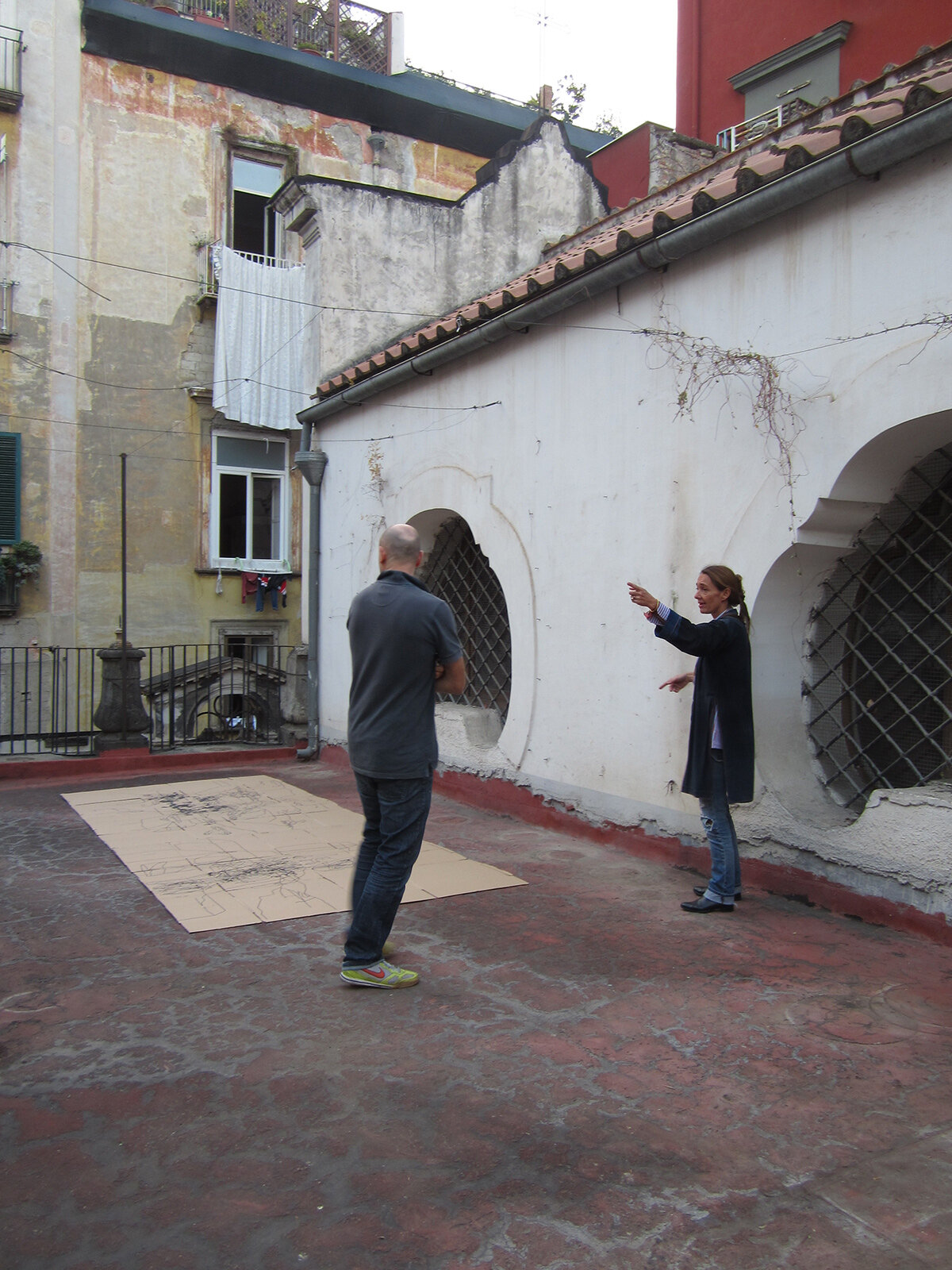
Purgatorio, Kaplan Project, 1/11/2011
Photo © Caroline Messensee
Exhibition view
They could have remained pieces of ordinary cardboard boxes with enigmatic designs drawn on them with a black marker, but the space that they occupied and the position they held for a few hours on the terrace of the renowned Neapolitan monument last November gave them a symbolic importance and significance that they would carry with them wherever they were transported.
They have become intertwined with vectors able convey a series of data that is more or less part of our lives:
This installation took place on All Saint's Day, day of the dead, shortly before the keys to this well travelled place named "Purgatorio" were handed over, an act symbolic of mandatory passage. The departure from one place, but on the 1.11.11...a clear symbol of a new start.
This "purgatory” occupied the extraordinary terrace of a renaissance palace built by the de Capua family. The name itself evokes the proverbial pleasures of Capoue that are representative of a precious time when people took advantage of life rather than planning their battles. A lesson that should not be forgotten.
MEMINI, the motto engraved above the doors and window, "I remember", quite in line with the philosophy of George Perec, is meant to be taken literally, as if to call upon you to remember. And the cardboard will forever bear the traces of the permanent ink.
These lines speak of paths across spaces and through time, paths that seem to forge into successive time periods overlapping one another. This is evident in Naples where the city center still has the original Greco-Roman layout intact. It was never truly destroyed and therefore was constructed as each civilization built upon what was already there over the course of 2800 years. History passes through the walls and floors, like the stain of the black marker in the deep divide, across the roofs and into the depths of the underground city.
A brass plate lies under the terrace stating that here lived San Gennaro, the patron saint of the city who was decapitated in 305. His blood was collected, and a ceremony of liquefaction is celebrated twice a year to ensure that the city will be safe from catastrophe. Placing the cardboard over one of the chapels at the San Gennaro all'Olmo church held within the palace is immersed in prayer and superstition.
Putting these boxes that were meant to transport items can also be viewed as a flying carpet that will float away and land elsewhere dropping off what it has carried and renewing the place it has settled, of an item of passage and memory, or blood shed and hopes of protection.
It is difficult not to associate these boxes that were gathered from the streets to mountains of waste that pile up in the European capital of trash bins and the highly mediatized decomposition over the past five years, the time of a war defined by mediatized bombings for the same efficient result -- the ruin of many for the profit of others.
A drawing on cardboard boxes to be a symbolic fragment of archeology. From Sumer to Grand Greece our roots are traced, as are those of the artist with an Iraqi architect for a father, a man who had to leave Najaf, then Baghdad -- lands where the wealth of petrol fuels the war of our times.
The starting point for this "Ersatz" was thus Naples, a perfect substitute. It remains, according to Malaparte "the most mysterious city of Europe, the only ancient city in the world that has not perished as have Ilion, Ninive, and Babylone. It is the only city in the world that has not sunk into the oblivion as other ancient civilizations have. Naples is the Pompei that has never been laid to rest. It's not a city, it's a world. The ancient pre-Christian world that has remained intact on the surface of the modern world."
Nathalie H. de Saint Phalle, Egyptologist and writer.
English Version (Translation)
Cela aurait pu n’être qu’un innocent morceau de carton comportant quelques énigmatiques dessins tracés au marker noir, mais l’emplacement occupé pendant les quelques heures du 1er novembre dernier sur une terrasse monumentale napolitaine l’a chargé de signifiants et de symboliques qu’il transportera désormais où qu’il aille.
Il s’agit donc d’un entrelacs de vecteurs susceptibles de nous transmettre une série de données toutes plus ou moins constituantes de nos vies:
Cette installation eut lieu de la Toussaint au jour des morts à la veille de rendre les clés d’un lieu très traversé nommé « Purgatorio », symbolique d’un passable obligé. Départ d’un lieu, mais le 1/11/11… Donc de fait symbole d’un nouveau départ.
Ce « purgatoire » a occupé douze ans l’extraordinaire terrasse d’un palais renaissance construit par la famille de Capua dont le nom fait surgir les proverbiales délices de Capoue qui signifient la perte d’un temps précieux à s’abandonner aux plaisirs au lieu de se préparer à la lutte. Une mise en garde à ne pas écarter.
MEMINI, la devise inscrite au-dessus des portes et des fenêtres, « Je me souviens » très perecquien, est à prendre à la lettre, comme une invitation à la mémoire. Et le carton conservera les tracés à l’encre indélébile.
Ces lignes évoquent des traversées d’espaces mais aussi de temps et semblent creuser dans la superposition des époques s’étant succédées en se recouvrant les unes les autres. Ainsi à Naples, dont le centre antique a conservé le plan originel gréco-romain et qui jamais vraiment détruite s’est construite par empilement de civilisations depuis 2800 ans, l’histoire traverse-t-elle tous les murs et les sols, comme le tracé en abîme du marker noir, des toits jusque dans les profondeurs de la ville souterraine.
Sous la terrasse une plaque indique que là vécut San Gennaro, le saint patron de la ville décapité en 305 et dont le sang recueilli doit se liquéfier deux fois par an pour garantir la ville des pires catastrophes. L’emplacement du carton juste au-dessus d’une des chapelles de l’église San Gennaro al Olmo imbriquée dans le palais est donc imprégné de très humaines prières et superstitions.
Cet assemblage de cartons d’emballage faits pour transporter est aussi à voir comme un flying carpet qui ira se poser ailleurs et y déposer son contenu fait de fins et de renouveau, de passage et de mémoire, de sang versé et d’espoir de protection.
Et comment ne pas associer les cartons d’emballages récupérés dans la rue aux montagnes de déchets s’entassant dans la capitale européenne des poubelles et d’une décomposition hyper médiatisée ces cinq dernières années, le temps d’une guerre de plus faite de bombardements médiatiques pour un résultat efficace toujours identique, la ruine des uns profitant à d’autres.
Un dessin sur des cartons comme fragment symbolique d’archéologie. De Sumer à la Grande Grèce, se dessinent nos racines, et celles de l’artiste dont le père architecte irakien a dû partir de Najaf puis de Baghdad, terres convoitées objectif pétrolifère des guerres de notre temps.
Le point de départ de cet « Ersatz » aura donc été Naples comme parfait substitut. Elle reste, selon Malaparte, « la ville la plus mystérieuse d’Europe, la seule ville du monde antique qui n’ait pas péri comme Ilion, comme Ninive, comme Babylone. C’est la seule ville au monde qui n’a pas sombré dans l’immense naufrage de la civilisation antique. Naples est un Pompéi qui n’a jamais été enseveli. Ce n’est pas une ville : c’est un monde. Le monde antique, préchrétien, demeuré intact à la surface du monde moderne. »
Nathalie H. de Saint Phalle, égyptologue et écrivaine.
French Version (Original)