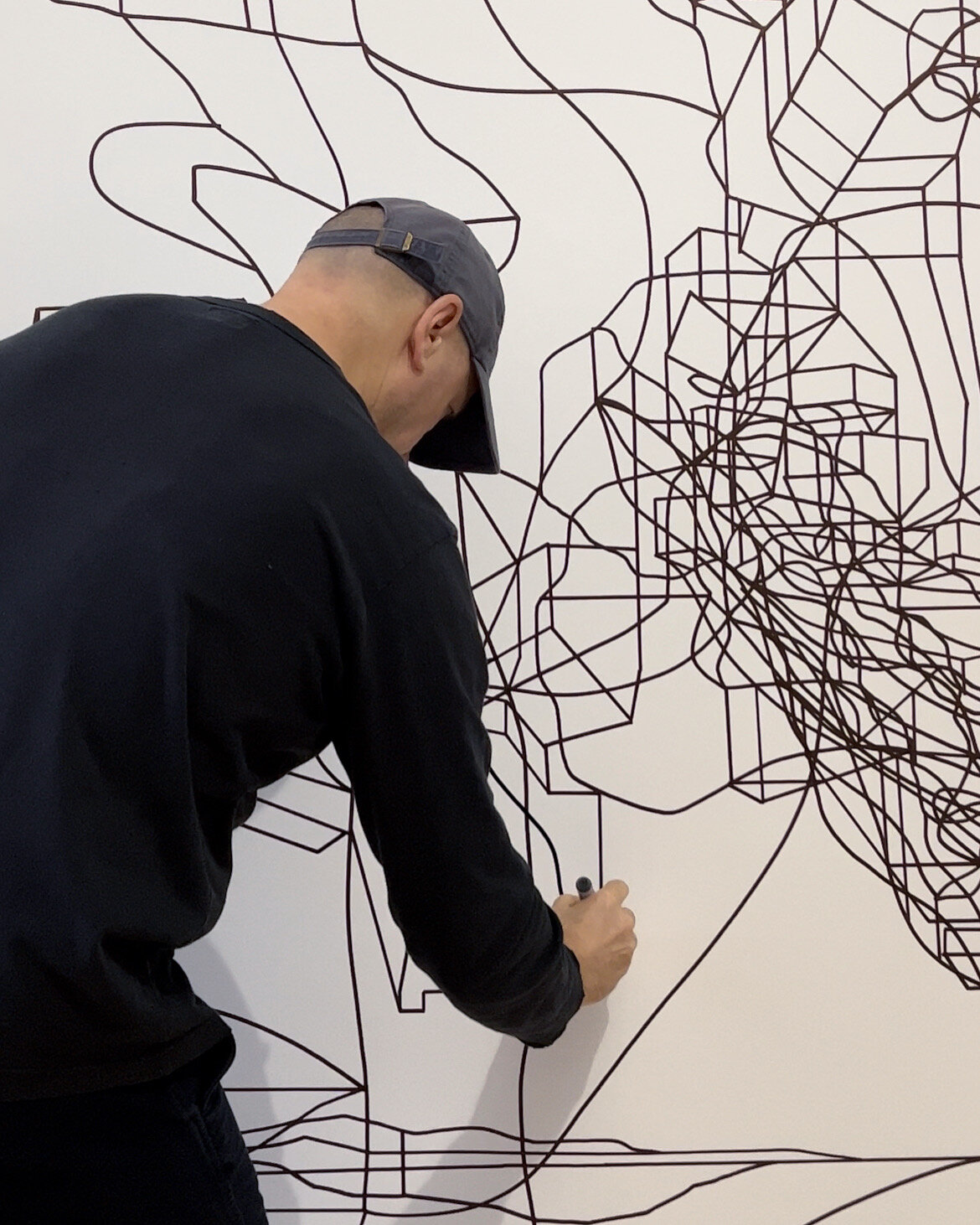
Octobre 2018 sera le mois des « Créateurs d'étendues ». Celui des artistes qui mettent en oeuvre des espaces qu'ils ont au sens propre, au sens de la géométrie, eux-mêmes conçus. Le Palais de Tokyo accueille Tomas Saraceno alors que la galerie Bertrand Grimont reçoit Laurent Ajina. Le premier oeuvre avec des araignées qui montrent une centaine de gigantesques toiles en fil de soie. Le second peint à l'encre d'énigmatiques artefacts de fils, longs traits colorés évanescents et flottants. Des traits qui débutent, à l'instar de l'insecte, à partir d'un angle de porte, d'une plinthe, d'un point d'accroche quelconque pour hanter obsessionnellement les lieux ; des enchevêtrements abstraits, toujours un peu monstrueux, toujours un peu déréglés que l'artiste construit avec une nécessité quasiment instinctuelle comme s'il voulait nous indiquer un refuge possible. Rappelons que Laurent Ajina a étudié l'architecture et qu'il développe depuis une dizaine d'années cette manière singulière de composer avec les surfaces quel que soit le support : mur, plafond, toile, papier. Il convient d'ajouter qu'en une dizaine d'années de pratique son trait s'est lentement simplifié. Qu'il a quitté le côté graphique et sombre, un peu touffu qu'il a longtemps côtoyé au profit d'un tracé plus léger, plus aérien, plus arrondi, avec dorénavant plus de vide que de plein, tout en intégrant parfois des éléments organiques ou minéralogiques. Oeuvrant d'une manière apaisée et de façon plus visible avec son passé, donnant peut être à voir les cartographies imaginaires des nombreux voyages vécus dans son enfance, mais aussi du présent, celles engendrées par les longues promenades en montagne ou encore à Vienne, la ville où il réside et travaille. Sur les murs de la galerie Bertrand Grimont, ce sont des lignes flottantes produites exclusivement avec son outil de prédilection ; un marker qu'il emplit pour la première fois d'une encre bleue cyan extra-fine à base d'acrylique afin de capter davantage de lumière. Ce sont aussi des grandes toiles élaborées avec le même processus mais cette fois-ci, de façon plus expressionniste, avec des fonds davantage colorés et puis des repentirs, des grattages, des superpositions ; des signaux d'errances, marqueurs d'un monde devenu nomade où désormais la traçabilité l'emporte sur l'identité.
October 2018 is the month of “Creators of Expanse”, one of artists who construct areas that they have literally and geometrically conceived. The Palais de Tokyo will host Tomas Saraceno, while the Bertrand Grimont Gallery will welcome Laurent Ajina. The prior uses spiders to expose a myriad of gigantic webs of silk. The latter traces enigmatic artefacts in scores of ink, long vacillating and evanescent streaks of colour. Lines extend from a rigging point, a skirting board, the angle of a door, any point that can anchor the constructions that obsessively haunt the spaces. Abstract entanglements, fiendish and dissolute, that the artist builds with a near instinctual urge as if to offer us a potential refuge. One must remember that Laurent Ajina previously studied architecture, and throughout the past decade has been developing this unique method of tracing on the surface of materials : walls, ceilings, canvas, paper. One may note that over the course of the years, the graphic and sombre lines in dense constructions that Ajina once favoured have given way to lighter, more rounded and aerial lines creating more space than composition, all the while leaving room for organic and mineralogical materials to be integrated into the constructions. Elaborating his works with calm and a more visible relation to his past, Ajina is perhaps revealing the cartograms etched in his mind from the numerous travels of his youth, as well as those of the present; cartograms engendered by his long walks in the mountains or promenades in the streets of Vienna where he lives and works. The walls of the Bertrand Grimont gallery host vacillating lines traced exclusively with Ajina’s tool of predilection; a marker, filled for the first time with extra fine cyan blue acrylic ink enabling the artist to capture more light. The walls also host large canvases elaborated in the same manner, but this time with a more expressionist technique. The backgrounds have more colour, there are pentimentos, scrapings, and superpositions ; indications of wandering, markers of an increasingly nomad world where traceability triumphs over identity.