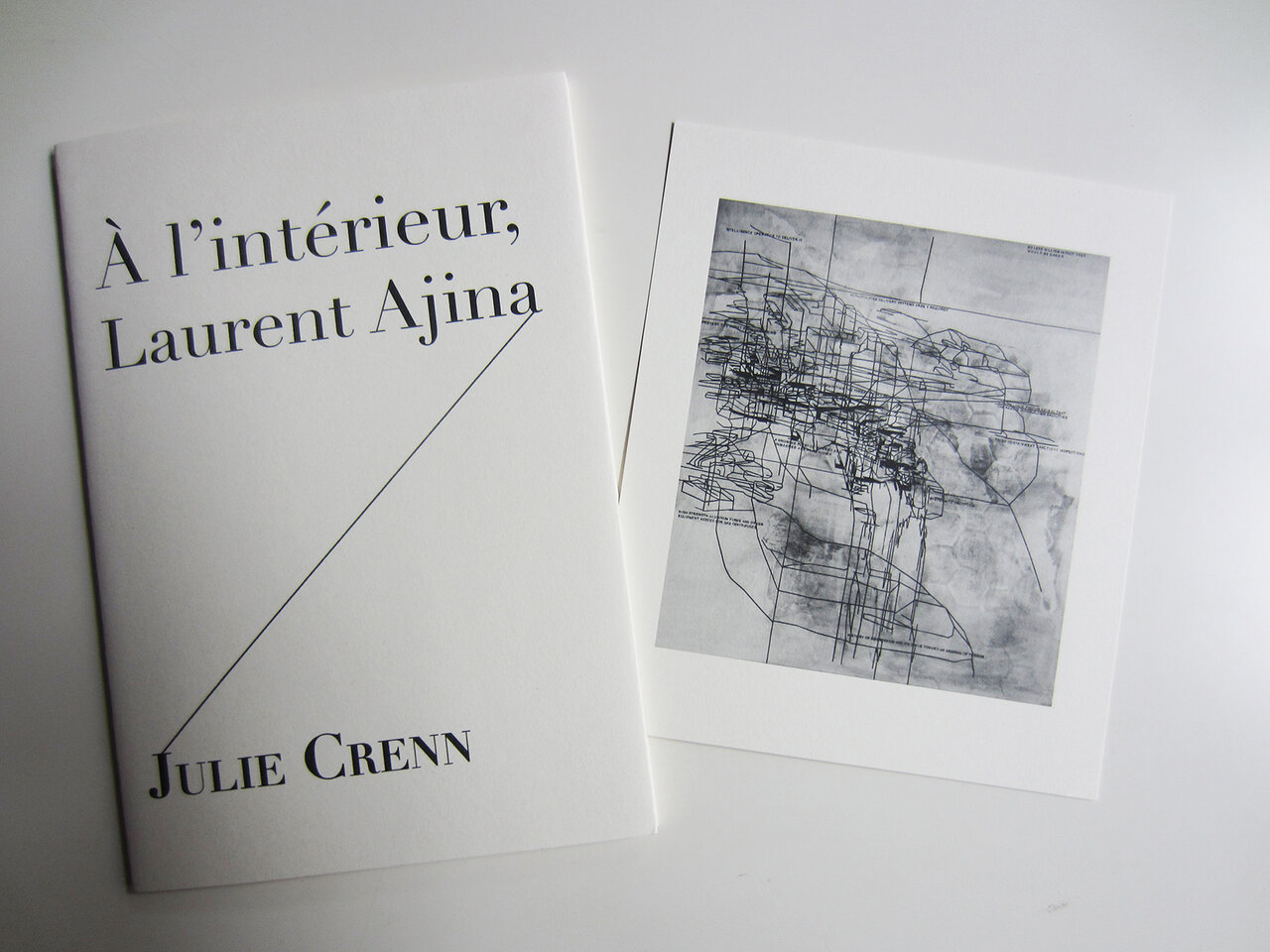
The latest works of Laurent Ajina mark the beginning of a new stage in his art. Until now, Ajina's work has been uniquely identified by Site Specific Drawings on the walls of various exhibition spaces that he transforms with his black paint markers. Plaster, paint, or cement... networks of lines stretched across the walls come together to define the environment. Existing lines are extended creating a temporal graphic web that entwines both artist and space. The rhizomic compositions interpret the dynamic, intense relationship between Ajina's body and the space that it occupies. Today he is taking his drawings beyond the walls and creating a series of works that expresses his relationship with space, the environment, infrastructure, and memories.
Ajina absorbs the geography and topography of the cities he travels through. He walks along unknown paths examining surrounding territories, extracting the images that strike him. As he sat at the base of the Sandkogel mountain in Austria in 2010, he began feverishly drawing the lines and forms before him. "I always have the same approach. When I travel, I look for the most opportune locations. When I find one, I begin rapidly drawing the image before me, obsessively recreating the same motif one after another by the hundreds.[1]” Eighty sheets of graph paper; an exercise of repetition progressively engraving the image in his mind. It's a matter of rhythm and mastering the strokes. Once the sheets of paper are reunited, the original motif is set into motion and is transformed by the artist's efforts. The title of the works calls us to Come Closer and examine the lines that float and move. The mountain fades away leaving in its place a series of drawings whose progressive modulations testify to the rigorous and breathtaking relationship between the artist, his subject, and the paper.
The motifs used by Laurent Ajina are always inspired by what he has seen. He takes his inspiration from the city and his immediate surroundings to visually express his relationship with space. In 2011, on the terrace of a castle in ruins in Naples (Palazzo di Capua), Ajina laid pieces of unfolded cardboard across the ground. Ersatz (Palazzo di Capua) is the graphic translation of the artist’s visual and psychological vibe faced with the ruins of this ancient neopolitan baroque palace in a profoundly inspiring city; a city littered with these ersatz of times which have long since faded away. The artist forges a path through them all. He slips his way into the crevices of the past to bring forth his contemporary vision of times long gone. Lines define the decrepit nature, the physical and emotional attachment that he has for this landscape that has been weathered with the time. Ruins that invite the observer to walk along its lines so that everyone can find their place in this augmented space. The cardboard work is not set to remain in Naples, it is scheduled to be presented in new cities, new countries, and new landscapes that the artist will be faced with. The precarious material, ersatz of the consumer society we live in, was initially designed to transport merchandise, and will retain its transient characteristic as the exhibit travels from one place to the next. "It will therefore be a ruin, a piece of archeology, a transported fragment" as it journeys from one city to the next. It involves a work of encrustation and the relationship between the territories and the temporalities. A nomadic approach that makes one recall the psychogeographical concept developped by Guy Debord in the 1950's.
Psychogeography could set for itself the study of the precise specific effects of the geographical environment, consciously organized or not, on the emotions and behaviour of individuals. The adjective psychogeographical, retaining a rather pleasing vagueness, can this be applied to the findings arrived at by this type of investigation, to their influence on human feelings, and even more generally to any situation or conduct that seems to reflect the same spirit of discovery. [2]
Guy Debord has written that Parisian subway maps have a certain "beauty" because they are the "sum of possibilities" for anyone who is taking the subway. If we transpose this notion to Laurent Ajina's topographic and architectural surveys, we see that they are the sum of innumerable possibilities, malleable and shifting as they are subject to his experience with ever changing spaces and locations.
The second component opens up on works which are both autobiographical and political, allowing us to come a bit closer to the artist's background. Without exposing himself or revealing all of the details, his works tell of his father's Iraqi origins, of a land symbolic of a fleeing world. Untitled (October 7, 2002 - September 12, 2002) - 2012 is a visual and textual dialogue between representations of Iraqi landscapes produced from childhood memories and fragments of George W. Bush's speeches. "The words redefine the areas of the landscape where the memory of my travels as a child intertwine with the shadowy contemporary definition of this country in a world of sensationalized media-communication. "The past and the present, the artist’s history, and a country in reconstruction clash. On large canvases darkened by a work of successive passages demanding "extensive periods of time to apply, evaporate, and strip, similar to erosion in nature", the images of Iraq engrained in the artist's mind become one with the words of the man that disfigured it, both humanly and materialistically. The whiteness and sharpness that have characterized Ajina's work until now make way for soiling, impurity, and darkness which all symbolically and physically express his efforts to recall the images and his commitment.
I was born in France in 1970 to an Iraqi father and a French mother. We lived in Paris. I have a vague memory of spending vacation at my grand-father's house in Najaf, then in Bagdad up until the 1980's when the Iran-Iraq conflict began. Two Gulf Wars then followed. I haven't been back for over thirty years. Those in my family who haven't been buried in the cemetery in Najaf for centuries already are part of a diaspora spread out to the four corners of the world. I had a sense of this globalization as a child as I went down the hallways of UNESCO and passed people of many different faces. My father's travels as director of urban development in Africa (he was an architect by trade) fed my notion of mobility.
Just as he does with his wall drawings, Ajina brings to life a system of graphic networks which englobe stylised architectural elements along with the words of the former American president. The obscure clouds that pass through the compositions recall the way the war tore through a country and a people, leaving them mutilated to this very today. Laurent Ajina creates a caustic criticism of imperialism and the exploitation imposed by Westerners who, based on the cowardly pretext of a national threat, went to war against a country to merely rob it of its resources. Ajina continues by stating: "The bits of sentences remain enigmatic without being specifically aimed at a country, speeches are cut, amputated of what made them intelligible in the literary sense of the speech. They become just as much legends of transition which set up the drawing mechanism as they are points of rupture, questions that get us nowhere.” A commentary made through a series of Black Stone pencil drawings, Ruins of Hypocrisy - 2012 when he made a concentrated effort to recollect memories from long ago. Silted landscapes, bustling cities and buildings that Ajina discovered throughout his various childhood journeys. The lines left behind by the Black Stone pencil on the sandy or brown paper resonate cries of a far off desert and the fantasy fueled by a fragmented memory, a family's history, and a traumatizing reality. The ruins of hypocrisy are the amalgam of the shock between Ajina's personal life and political beliefs, seen throughout the architectural networks.
Laurent Ajina produces a work relational as established by Edouard Glissant. He succeeds in bringing together various axes of reflection at a give point: the city, its history, its current state, and his own personal experience. The lines that he stretches across space on the paper, the cardboard, or the canvas create networks as he unravels first impressions, long considered critiques, and intuitive associations with memories of the past.
The notion of the trace goes against the grain of traditional thinking, and wanders forth, leading the viewer along its path. We recognize that this trace, this path, is what brings us together, no matter where we come from, and allows us to commune together. But this trace was once lived by a mere few in a place so removed, so distant yet so close, on the hidden face of the earth as a place of survival. […] The trace is neither an unfinished path that causes us to stumble as we move forward, not is it a dead-end alley along the border. The path goes into the earth where there will no longer be territories. The trace is an opaque expression that teaches wind and branch: to be oneself, derived. It is the sand in the true disorder of utopia. […] It is the violent wandering of the thoughts that we share.[3]
Construction based on developing networks and relational deviations that the artist uses to illustrate how he relates to the world and its spaces, how he engages in a physical, graphical, and emotional dialogue. The works are the result of minimalist and substantial traces derived from an intimate conversation with a place that he prolongs or cuts short in temporary fusion.
[1] All of the quotations are exerpts from an interview with the artist in March 2012.
[2] DEBORD, Guy Ernest. « Introduction to a critique of urban geography » in Lèvres Nues, n°6, 1955, p.11.
[3] GLISSANT, Edouard. Treatise on the Whole World (Traité du Tout Monde) (Poétique IV) Paris : Gallimard, 1997, p.18-20.
English Version (Translation)
Les dernières productions de Laurent Ajina marquent une nouvelle étape dans sa démarche artistique. Celle-ci était jusque-là uniquement identifiée par l’exécution des Site Specific Drawings sur les murs des différents lieux d’exposition qu’il est invité à investir de ses markers noirs. À même le plâtre, la peinture ou le béton, il étire des réseaux qui viennent composer l’espace. Il prolonge les lignes préexistantes et génère une véritable résille graphique concrétisant de manière temporaire une totale fusion entre l’artiste et le lieu. Les compositions rhizomiques traduisent une dynamique, une relation intense entre son corps et l’espace dans lequel il agit. Aujourd’hui, il déploie ses dessins au-delà des murs et formule une œuvre sérielle à travers laquelle il précise et développe sa relation à l’espace, à l’environnement, au bâti et à la mémoire.
Ainsi, il s’imprègne de la géographie et de la topographie des villes traversées. Il marche et examine des territoires nouveaux, inconnus, dont il extrait des motifs. En 2010, en Autriche, il dessine de manière frénétique une montagne (Sandkogel) dont il schématise rapidement les lignes et les formes. « Le procédé reste toujours le même, lors de mes voyages je cherche des lieux propices, j’enchaîne les dessins de manière très rapide, de manière obsessionnelle par centaine. »[1] Sur quatre-vingts feuilles normées à petit carreaux, il s’emploie à un exercice de répétition et d’accumulation d’un même motif. Tout est une question de rythme et de gestion du trait. Une fois les feuilles rassemblées, le motif initial se met en mouvement, il se transforme au fil de l’effort produit par l’artiste. Le titre de l’œuvre nous incite à nous rapprocher (Come Closer) et à scruter les lignes flottantes et mobiles. La montagne disparaît et laisse place à une série de motifs dont les modulations progressives figurent une relation à la fois exigeante et vertigineuse entre l’artiste, le sujet et le papier.
Les motifs appropriés par Laurent Ajina proviennent toujours du réel. Il s’inspire de la ville et de son environnement direct pour expliciter visuellement son rapport à l’espace. En 2011, à Naples, sur la terrasse d’un palais en ruines (Palazzo di Capua Marigliano) il couche au sol des pièces de cartons dépliés. Ersatz (Palazzo di Capua Marigliano) – 2011 est la traduction graphique du ressenti visuel et psychologique de l’artiste face aux ruines de cet ancien palais baroque napolitain et plus largement à une ville qui l’inspire profondément. Une ville parsemée de ces ersatz des époques évanouies parmi lesquels l’artiste se fraye un passage. Il se glisse dans les failles du passé pour faire surgir une trace contemporaine, la sienne. Les lignes désignent la décrépitude, l’attachement physique, émotionnel qu’il éprouve pour ce paysage abîmé par le temps. Des ruines sur lesquelles le regardeur serait invité à traverser en marchant sur les traits, afin que chacun puisse trouver sa place dans cet espace augmenté. L’œuvre sur carton n’est pas enracinée à Naples, au contraire elle est destinée à être présentée dans de nouvelles villes, de nouveaux pays, de nouveaux paysages auxquels il va se confronter. Le matériau précaire, ersatz de la société de consommation, initialement voué au transport de marchandises, conserve ainsi sa fonction ambulante. « Ce serait donc une ruine, une archéologie, un fragmenté transporté » d’une ville à une autre. Il engage alors un travail d’incrustation et de relation entre les territoires et les temporalités. Une démarche nomade qui nous rappelle le concept de psychogéographie développé par Guy Debord dans les années 1950.
La psychogéographie se proposerait l’étude des lois exactes, et des effets précis du milieu géographique, consciemment aménagé ou non, agissant directement sur le comportement affectif des individus. L’adjectif psychogéographique, conservant un assez plaisant vague, peut donc s’appliquer aux données établies par ce genre d’investigation, aux résultats de leur influence sur les sentiments humains, et même plus généralement à toute situation ou toute conduite qui paraissent relever du même esprit de découverte. [2]
Guy Debord, en parlant des plans du métro parisien, écrit qu’ils portent une « beauté » parce qu’ils sont une « somme de possibilités » pour ceux qui empruntent le métro. Si nous transposons cette notion aux relevés topographiques et architecturaux de Laurent Ajina, nous constatons qu’ils apparaissent comme des sommes de possibilités immenses, elles sont malléables et mouvantes puisqu’elles obéissent à son expérience avec des espaces, des lieux, toujours différents.
Un second volet s’ouvre sur des œuvres dont le contenu à la fois autobiographique et politique, nous permet d’approcher d’un peu plus près de l’histoire de l’artiste. Sans se mettre à nu, ni se livrer totalement, il distille des indices qui se rapportent aux origines irakiennes de son père, une terre comme un symbole d’un monde en fuite. Untitled (october 7, 2002 – september 12, 2002) – 2012, est un dialogue visuel et textuel entre la représentation de paysages irakiens élaborés selon des souvenirs d’enfance et des fragments de discours de George W. Bush. « Ces mots redéfinissent les zones du paysage où se mêle la mémoire de mes voyages d’enfance à la définition contemporaine quasi fantasmagorique de ce pays dans le monde de l’hyper média-communication. » Le passé et le présent, l’histoire de l’artiste et celle d’un pays en reconstruction se télescopent. Sur de grandes toiles assombries par un travail de passages successifs exigeant de « longs temps de pose, d’évaporation, de décapage, proche du travail d’érosion de la nature », l’Irak mémorisé par l’artiste fusionne avec les mots de celui qui l’a défiguré, humainement et matériellement. La blancheur et la netteté qui caractérisaient son œuvre jusqu’ici, laissent place à la salissure, à l’impureté et à la noirceur qui traduisent de manière symbolique et physique ses efforts mémoriels et son engagement.
Je suis né en France, en 1970, de père Irakien et de mère Française. Nous habitions Paris. J’ai le souvenir diffus de vacances passées dans la maison de mon grand-père à Najaf puis à Bagdad jusqu’en 1980 qui marque le début du conflit Iran-Irak. S’en suivirent deux guerres du golf, cela fait trente ans que je n’y suis pas retourné. Les membres de ma famille qui ne sont pas enterrés dans le cimetière de Najaf depuis des siècles font partie d'une diaspora dispersée aux quatre coins du monde. J'avais déjà conscience de cette mondialisation lorsque, enfant, je traversais les couloirs de l'UNESCO et croisais des personnes aux visages très différents. Les voyages de mon père, responsable de programme de développement urbains en Afrique, (mon père était architecte) ont alimenté mon imaginaire du déplacement.
Comme pour ses dessins muraux, il réactive un dispositif de réseaux graphiques au sein desquels sont incorporés des éléments architecturaux stylisés et les mots de l’ancien président américain. Les obscures nuées qui traversent les compositions évoquent le passage de la guerre sur un pays et une société aujourd’hui mutilés. Laurent Ajina produit une critique acerbe contre l’impérialisme et l’exploitation imposés par les Occidentaux qui sous le lâche prétexte d’une insécurité internationale, partent en guerre contre un pays pour le piller de ses ressources. Il précise : « Les bouts de phrases samplés restent énigmatiques, aucune désignation directe du pays, les allocutions sont découpées, amputées de ce qui les rendrait intelligibles au sens littéraire du discours, ils deviennent tantôt des légendes des transitions qui organisent la mécanique du dessin, tantôt des points de rupture, des interrogations qui tournent à vide ». Un commentaire qu’il poursuit dans une série de dessins à la pierre noire, Ruins of Hypocrisy – 2012, où il s’emploie à matérialiser ses lointains souvenirs. Des paysages ensablés, des villes et des bâtiments fréquentés, qu’il a découverts pendant différents voyages réalisés alors qu’il était enfant. Les traits de pierre noire sur des feuilles de papier couleur sable ou brun, en résonnance avec le désert, participent à l’évocation d’un fantasme nourrit d’une mémoire fragmentée, d’une histoire familiale et d’une actualité traumatisante. Les ruines de l’hypocrisie sont celles de cet amalgame où le personnel et le politique s’entrechoquent au fil des réseaux architecturaux.
Laurent Ajina génère une œuvre relationnelle au sens donné par Edouard Glissant. D’un point spécifique il parvient à rassembler différents pôles de réflexion : la ville, l’architecture, l’histoire, l’actualité et son expérience personnelle. Les traits qu’il étire dans l’espace, sur le papier, le carton ou la toile, forment des réseaux où dialoguent impressions immédiates, correspondances critiques et associations intuitives liées à une mémoire dont il déploie les fils.
La pensée de la trace s’appose, par opposition à la pensée du système, comme une errance qui oriente. Nous reconnaissons que la trace est ce qui nous met, nous tous, d’où que venus, en Relation. Or la trace fut vécue par quelques-uns, là-bas, si loin si près, ici-là, sur la face cachée de la terre, comme l’un des lieux de la survie. […] La trace ne figure pas une sente inachevée où l’on trébuche sans recours, ni une allée fermée sur elle-même, qui borde un territoire. La trace va dans la terre, qui plus jamais ne sera territoire. La trace, c’est manière opaque d’apprendre la branche et le vent : être soi, dérivé à l’autre. C’est le sable en vrai désordre de l’utopie. […] Elle est l’errance violente de la pensée qu’on partage.[3]
Des constructions basée sur le développement de réseaux et de dérivations relationnelles que l’artiste met en œuvre pour mieux exprimer son rapport au monde et aux espaces avec lesquels il engage un dialogue physique, graphique et émotionnel. Les œuvres qui en résultent sont les traces minimalistes et substantielles d’une conversation intime avec un lieu dont il prolonge ou détache une fusion temporaire.
[1] Toutes les citations sont extraites d’une conversation avec l’artiste, mars 2012.
[2] DEBORD, Guy Ernest. « Introduction à une critique de la géographie urbaine » in Lèvres Nues, n°6, 1955, p.11.
[3] GLISSANT, Edouard. Traité du Tout-Monde (Poétique IV). Paris : Gallimard, 1997, p.18-20.
French Version (Original)