



Critical texts and Statements that reached me from allround the globe.
Text excerpted from California_Line, by Kimberly Marteau Emerson, Board of Directors Human Rights Watch
, Principal KME Consulting, Los Angeles, 2020
(...) In his photographic pieces, set, among other places, in California’s Joshua Tree wilderness, the Hungarian border, and Beirut, Laurent’s drawings on cardboard become transitory symbols in the landscape, seemingly random interventions themselves that jolt viewers into a heightened and sometimes ironic awareness of what they are visually experiencing. They are also somehow calming, as if the cardboard just showed up and sits contentedly in its new location amidst the serene grandeur of nature, or amidst the masculine visual noise of a construction site, reminding us that connections are everywhere, coming from somewhere, going to somewhere. Even in his choice of materials, Laurent is making very specific choices. For example, his employment of used cardboard as a base for his line drawings folds into his idea that this material has traveled from somewhere, to somewhere, containing something—it has an individual journey—and now will travel again in a different use, as part of a work of art also containing “some things.” This time those “some things” are ideas emerging and camouflaged in both intentional and auto-drawn lines that connect the cardboard to a greater reflection, a reflection on the power of connectivity and, with it, the possibility of transformation in the cardboard’s journey and, in a meta way, in all of our journeys, be they in Vienna, California or elsewhere. Through his artistic algorithms, Laurent teases the idea of reincarnation, of unexpected new life. And that brings hope. (...)
Text excerpted from MEMINI, by Nathalie H. de Saint Phalle, Egyptologist and writer, Naples, 2011
(...) They could have remained pieces of ordinary cardboard boxes with enigmatic designs drawn on them with a black marker, but the space that they occupied and the position they held for a few hours on the terrace of the renowned Neapolitan monument last November gave them a symbolic importance and significance that they would carry with them wherever they were transported. They have become intertwined with vectors able convey a series of data that is more or less part of our lives. (...)
(...) These lines speak of paths across spaces and through time, paths that seem to forge into successive time periods overlapping one another. This is evident in Naples where the city center still has the original Greco-Roman layout intact. It was never truly destroyed and therefore was constructed as each civilization built upon what was already there over the course of 2800 years. History passes through the walls and floors, like the stain of the black marker in the deep divide, across the roofs and into the depths of the underground city.
(...)
(...) It is difficult not to associate these boxes that were gathered from the streets to mountains of waste that pile up in the European capital of trash bins and the highly mediatized decomposition over the past five years, the time of a war defined by mediatized bombings for the same efficient result -- the ruin of many for the profit of others.
A drawing on cardboard boxes to be a symbolic fragment of archeology. From Sumer to Grand Greece our roots are traced, as are those of the artist with an Iraqi architect for a father, a man who had to leave Najaf, then Baghdad -- lands where the wealth of petrol fuels the war of our times. (...)
Excerpt, translated from French
Text excerpted from A MATTER OF FORM, by Silvie Aigner, editor-in-chief of Kunstmagazin Parnass, Vienna, 2019
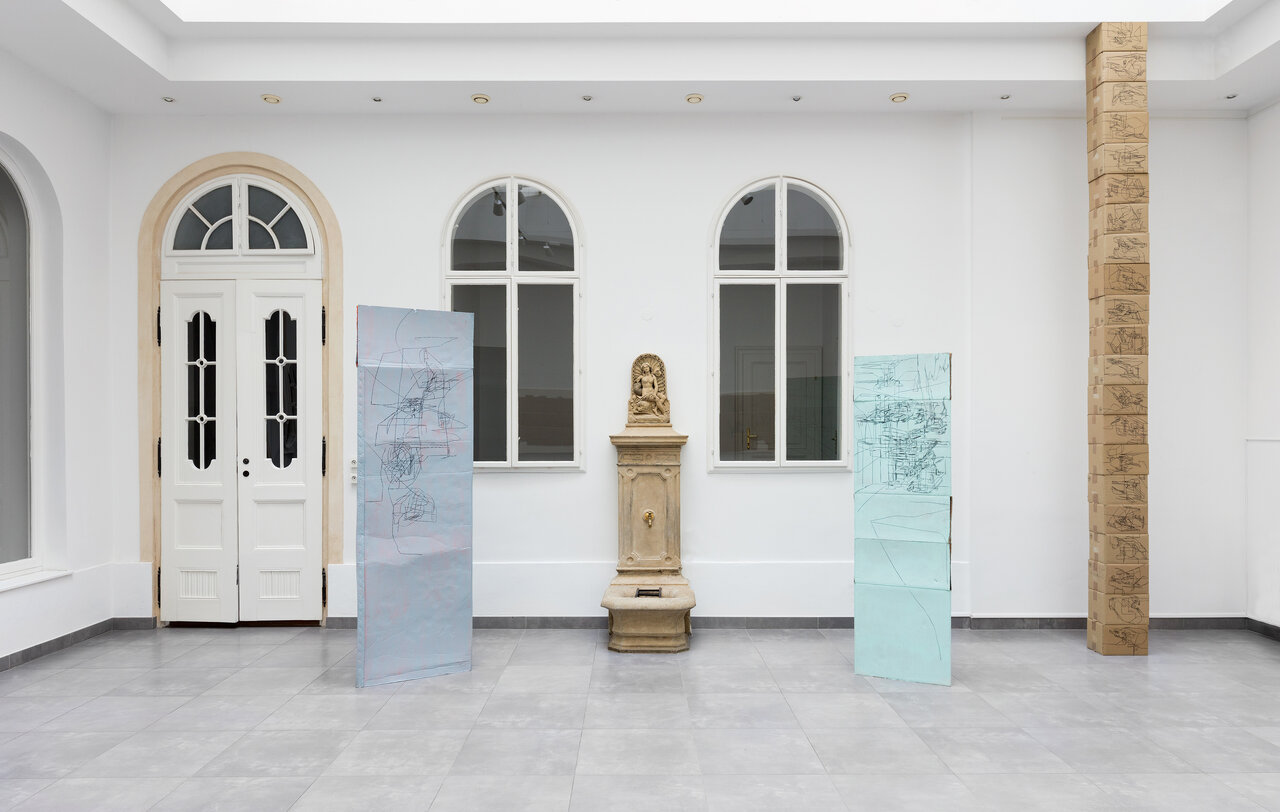
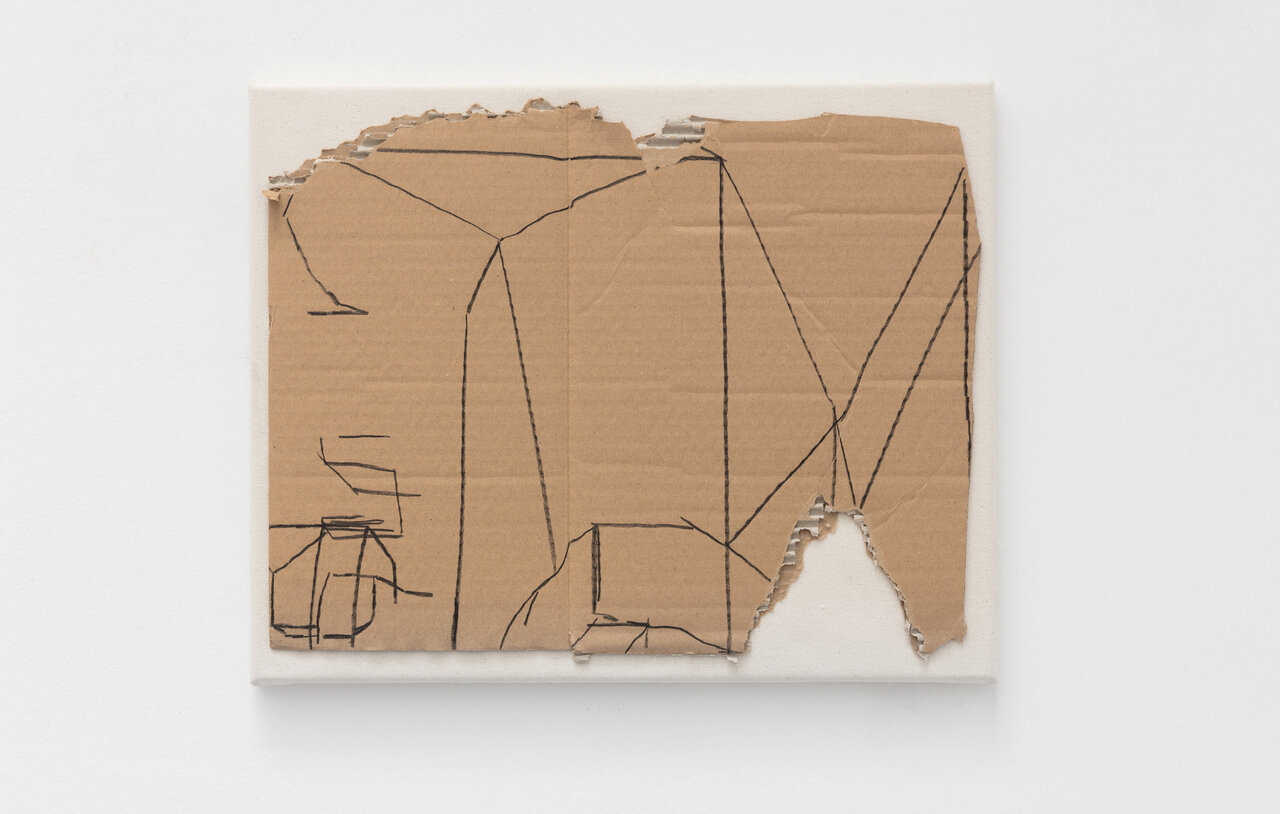
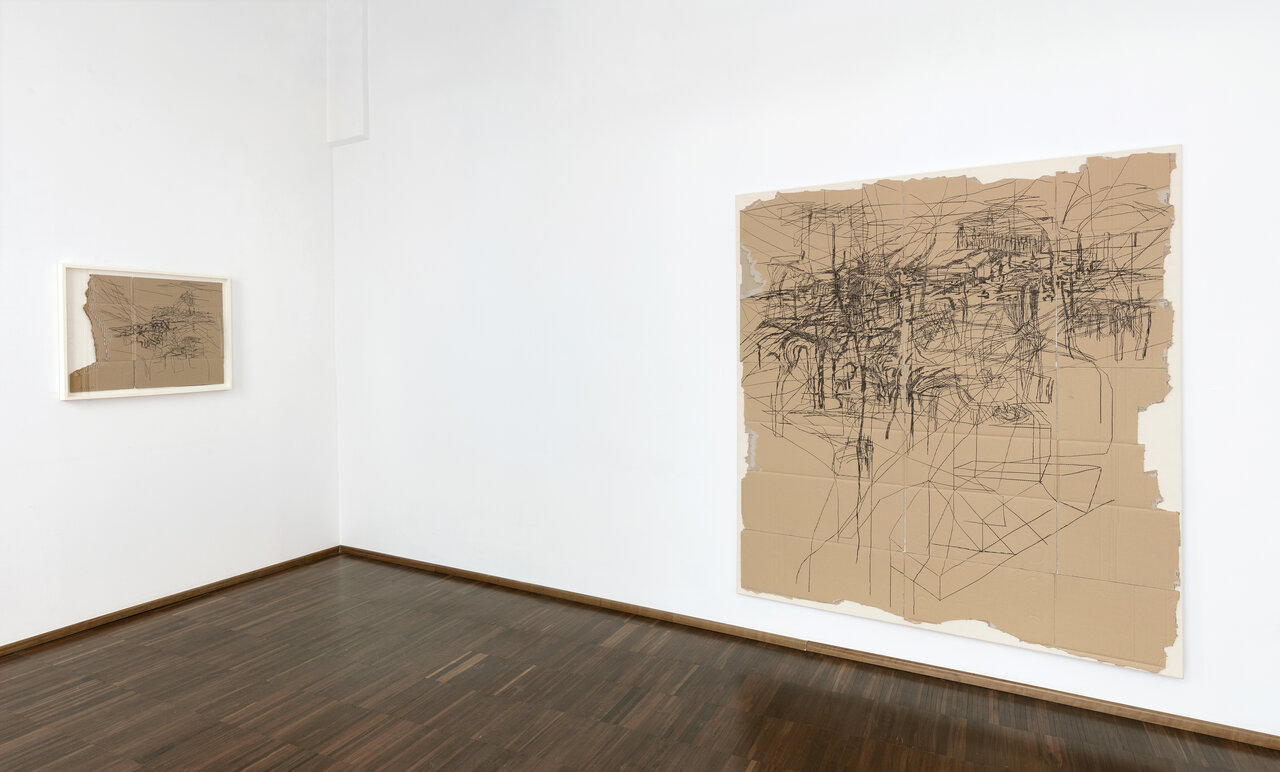
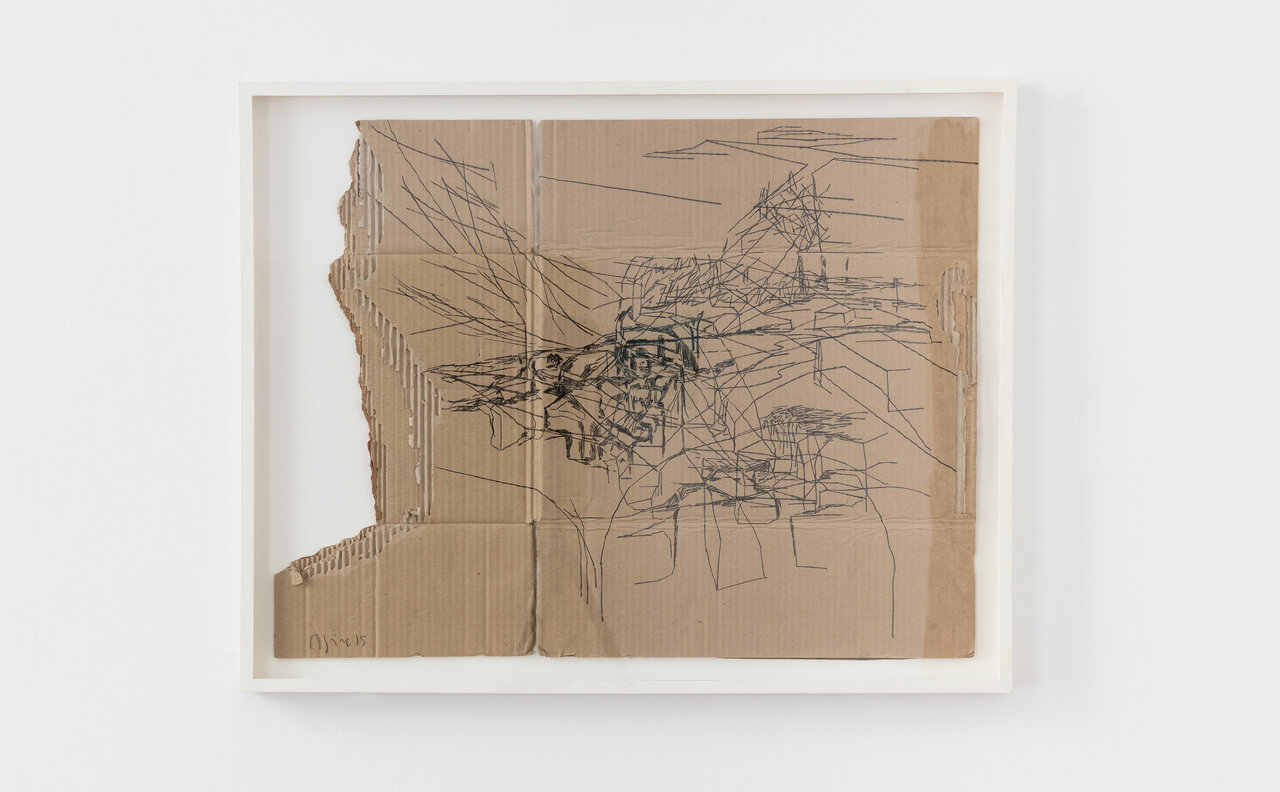
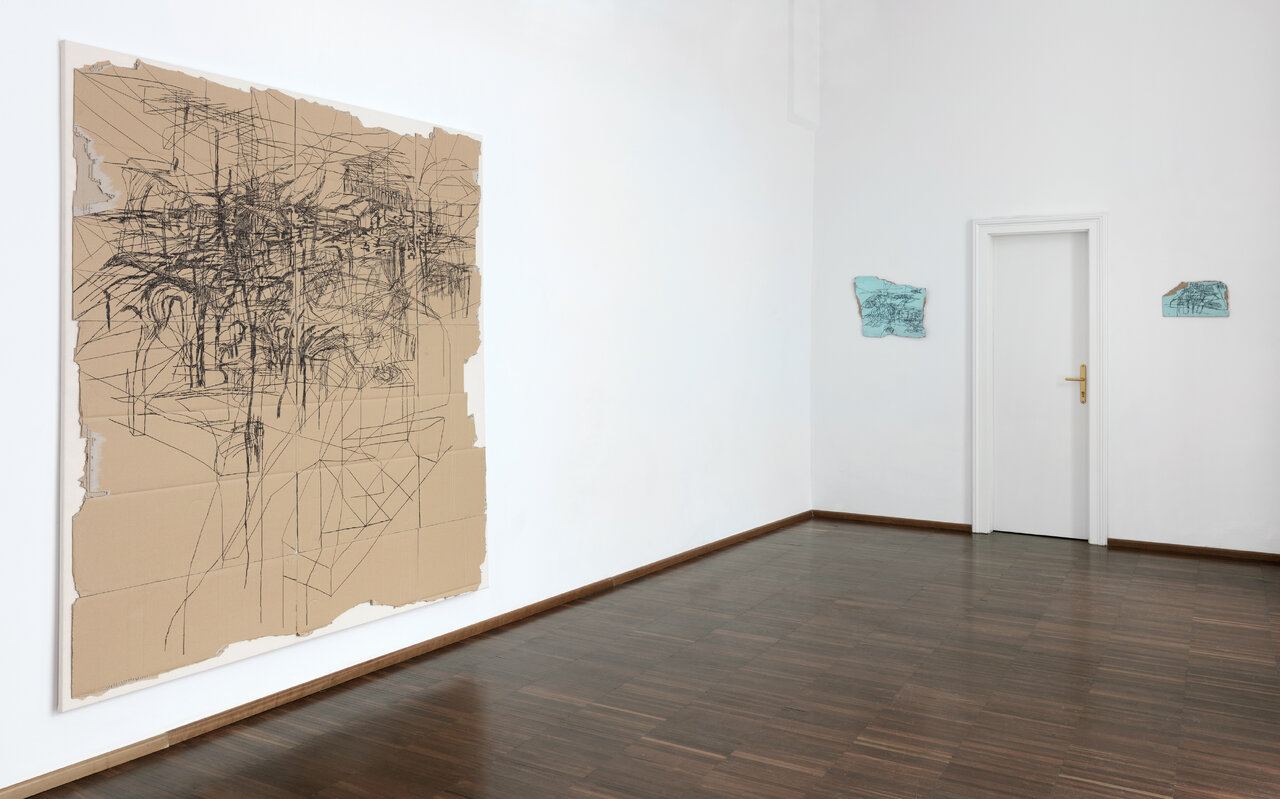
(...) He applies the designs to canvas and cardboard, which he folds or unfolds to create sculptures resembling steles. Since 2011, the artist has also placed them in real locations, forcing his artistic works to interact with their surroundings. This environment could not be more varied, ranging from the rooftops of Beirut with their satellite and antenna systems to Greek temples, the narrow streets of Venice, and the vast plains of the Austrian Burgenland near the Hungarian border. Here, sculpture becomes memorial and recalls the border watchtowers of the Iron Curtain era. Ajina uses only cardboard that has already been used. The artist collects it, unfolds it, places his drawing on it, and then transports it again. The final step, according to Ajina, is to install the cardboard in the immaculate White Cube of a gallery. Sometimes he paints his sculptures, as he did in 2017. A turquoise cardboard box, covered with a simple drawing, stands in the room like a stele. Thanks to the color and the new context, the disposable material regains its value, explains Ajina. Many of his paintings resemble wall objects, especially when he also uses cardboard as an image support. It is therefore not surprising that the artist actually draws his lines on the walls. (...)
Excerpt, translated from Deutsch
Text excerpted from Ajina, la ligne et l'espace by Stéphanie Pioda, art critic, and independent editor, Paris 2022
(...) This idea of movement is reflected in a project that emerged during lockdown, using a different material. “Cardboard came from my experience as a keen walker and pedestrian, and as a lover of architecture.” At the age of 20, struck by the visual impact of cardboard boxes placed on the ground by homeless people, embodying both a function (protection) and a defined space, as well as something tragic, he began photographing them in the street before choosing them as a medium for outdoor installations. While he evokes their fragility and perishable nature, Laurent Ajina now uses them more for what they represent to him: globalization and the now countless exchanges of goods, but also a fairly classic relationship with drawing. He uses a brown medium, where the 18th century preferred blue paper, and a black pencil that evokes charcoal. Since 2020, he has decided to send them on journeys to faraway places: Africa, Australia, Cyprus, the United States, Angkor... “I send my cardboard boxes to people who send me photos of the works in their surroundings in return.” It's a way of placing them in a landscape, like a window onto another world, and reminding us that these panels are pieces of his own inner landscapes. “There are good surprises and bad surprises, but that's part of the game. I hope to create a kind of map of the world with these photographs.” Torn, folded, cut up: the material he finds in stores is already marked, unlike the smooth, well-prepared walls of his wall drawings or his paintings. (...)
Excerpt, translated from French
Text excerpted from Laurent Ajinas Art, The Measurement of the World by Sebastian C. Strenger, art historian, curator, head of the European Art Association in Berlin. For ensuite, he is the department head for International Art & Market, Bern 2020
(...) In strong contrast to these color intense works on canvas are the drawings on cardboard boxes, which the artist presents lying on the floor or also folded into three-dimensional structures. The artist also used the line structures to take them with him on his travels as portable sculptures.
In the narrow alleys of Venice or on the stony hills of Greece, the artist integrates them into their surroundings, and they become part of the landscape or remain strange visitors in a larger environment. The motifs that emerge from this process are initially photographed by Ajina himself or captured on film, before his interventions are documented and shown in other places.
Ajina thereby creates a worldwide network of visual references at the mercy of infinity. Recently, his time in the Corona lockdown led him to form a global network with artists from his photographic oeuvre via Instagram, to whom he sends his cardboard drawings from then on so that they photograph his artwork in an ever-changing environment, and this will become part of his future exhibitions. His works have already traveled to about 80 locations - from Abu Dhabi to the other side of the world, from Canada to Australia. (...)
Excerpt, translated from Deutsch